Will, the bartender, stands staring at the matter compiler sitting on the corner of the bar. A tiny, frustrated voice echoes from within. Reverend Carl's scheme to remix Jesus using sacramental bread and wine appears to have worked.
"Seriously?" Will asks.
Beth sits at the bar, while John Cates stands nearby, momentarily distracted from his quest to obtain the cheese omelet that is his Heart's Desire. Bud, a rather enigmatic figure, remains sitting at the opposite end of the bar.
The multicolored seed winks from inside a terracotta ashtray.
Tuesday, December 06, 2011

Friday, November 11, 2011
Agora: Thumbs Up
Will, the scruffy barista, continues to tidy up the bar. Occasionally he picks up his cup of tea and takes a sip.
The matter compiler sits innocently at the end of the bar, a few feet from Beth, Vincent and John. Its "completed" indicator, a bright green thumbs-up symbol, glows cheerfully.
The matter compiler sits innocently at the end of the bar, a few feet from Beth, Vincent and John. Its "completed" indicator, a bright green thumbs-up symbol, glows cheerfully.
Saturday, October 29, 2011
Agora: Meta
This is the meta post, where we can talk about Agora (as opposed to your in-character comments, which ostensibly happen in Agora).
If you're playing along, you may want to subscribe to comments on this post, as well as the summary post, in case there's anything interesting going on.
If you're playing along, you may want to subscribe to comments on this post, as well as the summary post, in case there's anything interesting going on.
Monday, October 24, 2011
Agora: Beginning
The little shop sits on the slope of a small hill, looking down into a long, busy street that shoots straight into the heart of downtown. At the end of the street, blocks and blocks away, the old courthouse sits, delicate and ancient, surrounded by looming black skycrapers. Out here, though, the buildings are a bit less crowded and a bit more reasonably sized. This one sits at the edge of what used to be a boutique shopping district, and formerly housed an antique store with a horribly florid name: "Exilene's Land of Lovely Long-Ago Rarities" or something like that. The new owner slapped on a coat of dark blue paint to obliterate most of the sign, but left a few of Exilene's delicate, decisively serifed letters:
Ago Ra
Agora's storefront is entirely glass, allowing patrons inside to observe the commuters outside, and vice versa. On sunny days, someone occasionally drags a table out the front door and situates it on the sidewalk -- a little land grab into the commuters' territory -- but today it's a bit chilly, the west-facing storefront will be in shadow most of the day, and nobody seems terribly interested in rubbing elbows with pedestrians.
After passing through the front door, customers end up in the big main room, a few hundred square feet in size but partitioned into smaller spaces by roughly plastered walls. The partitions and plaster make the place feel a bit like a southwestern mission, split into cells populated by urban monks with a taste for joe and overstuffed Goodwill furniture. Parts of the bar are visible from the front door, but the path from here to there is less than direct. A heavy wooden door near the bar leads out to a patio.
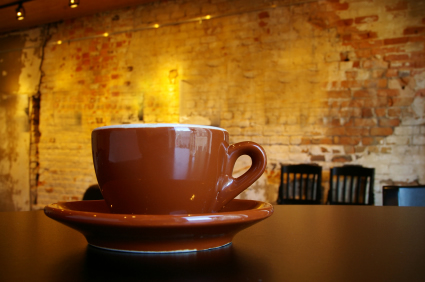
The bar itself is formidable, festooned with both coffee mugs and glassware, because Agora is an unusual mix of coffee shop and bar. It sells mostly caffiene in the morning and mostly alcohol in the evening, but everything is available all the time, and given the human variety in a city this size, it's not unusual to see the barista serving shots of whiskey at 5 in the morning, or a double shot of espresso at midnight.
Of course, baristas aren't strictly necessary these days. The place has a matter feed, a sleek gray rectangle tucked away on one corner of the bar, but it's primarily there as a concession to a certain sort of customer, usually a guest of a regular who won't take his beverage any other way. But most folks come to Agora precisely because they like things done in the old, aromatic way, with shining, hissing metal cylinders, multicolored bottles half-full of multicolored liquids, jiggers and shakers and plenty of steam.
Today, the man tending bar is a moderately scruffy, sandy-haired grad student named Will. Will spends a lot of his time reading, sometimes tending bar with a glass in his left hand and a book in his right. He also makes a tasty Irish Coffee. At the moment he's wiping down the bar with a white towel and whistling what sounds like a Beatles tune.
Ago Ra
Agora's storefront is entirely glass, allowing patrons inside to observe the commuters outside, and vice versa. On sunny days, someone occasionally drags a table out the front door and situates it on the sidewalk -- a little land grab into the commuters' territory -- but today it's a bit chilly, the west-facing storefront will be in shadow most of the day, and nobody seems terribly interested in rubbing elbows with pedestrians.
After passing through the front door, customers end up in the big main room, a few hundred square feet in size but partitioned into smaller spaces by roughly plastered walls. The partitions and plaster make the place feel a bit like a southwestern mission, split into cells populated by urban monks with a taste for joe and overstuffed Goodwill furniture. Parts of the bar are visible from the front door, but the path from here to there is less than direct. A heavy wooden door near the bar leads out to a patio.
The bar itself is formidable, festooned with both coffee mugs and glassware, because Agora is an unusual mix of coffee shop and bar. It sells mostly caffiene in the morning and mostly alcohol in the evening, but everything is available all the time, and given the human variety in a city this size, it's not unusual to see the barista serving shots of whiskey at 5 in the morning, or a double shot of espresso at midnight.
Of course, baristas aren't strictly necessary these days. The place has a matter feed, a sleek gray rectangle tucked away on one corner of the bar, but it's primarily there as a concession to a certain sort of customer, usually a guest of a regular who won't take his beverage any other way. But most folks come to Agora precisely because they like things done in the old, aromatic way, with shining, hissing metal cylinders, multicolored bottles half-full of multicolored liquids, jiggers and shakers and plenty of steam.
Today, the man tending bar is a moderately scruffy, sandy-haired grad student named Will. Will spends a lot of his time reading, sometimes tending bar with a glass in his left hand and a book in his right. He also makes a tasty Irish Coffee. At the moment he's wiping down the bar with a white towel and whistling what sounds like a Beatles tune.
Agora: Overview
 For a little while, this blog is going to become a coffee-shop-slash-pub called Agora. The basic mechanism is this: I will post an initial descriptive post. You folks will adopt a persona and, in the comment section, describe the actions and interactions of your characters. Characters who intend to stick around will be added to the roster below. If you would like your character's description to be added, please affix it as a comment to this post. Periodically, new suggestions and guidelines also will be added to this post.
Let's see how it go!
Links
- Meta
Discussion about what's currently going on in Agora.
- The Beginning
Wherein we meet Vincent, Beth and John, and ale is drunk.
- Thumbs Up
Wherein Beth and John consider the desirability of desire, and Carl hatches his scheme to usher in the Second Coming.
- Just a Little Talk with Jesus
Guidelines
Please post in the present tense. So write "Charlie walks in the door", not "Charlie walked in the door."
Please play along. This is a basic rule of improv, and here it means several things: one is to go with the flow of the conversation, but it also means to try not to dramatically alter the parts of the world that have already been created by other people.
Characters
Will
Will is a sandy-haired barista-slash-bartender who has worked at Agora for more than a year. A graduate student at a local university, Will is, as one might expect, a bit lean and scruffy, but otherwise not a bad looking fellow. He spends a lot of his time reading, sometimes tending bar with a glass in his left hand and a book in his right. He makes a tasty Irish Coffee.
Vincent
Vincent is a homesick Englishman, age uncertain but well beyond middle. Nor is he certain how he got to this town, with its West Coast feel--perhaps San Francisco, Seattle, Vancouver? He ought to know, wonders if dementia is starting to bite. If it is, he hopes to die of something else before he forgets who he is. At the first signs, he plans to start living more dangerously; and wonders if this is a suitable place to start--this town, this odd bar, which he thinks unlikely to serve English ale at cellar temperature.
Beth
Female.
John Cates
The man really wants a cheese omelet.
Bud
A rather enigmatic figure.
Carl the Cleric
Desires to remix Jesus using a matter compiler, sacramental bread and sacramental wine.
Saturday, October 15, 2011
A Game of Agora
 Oh, hi there.
 A few days ago, I ran into some interesting folks on Richard Beck's blog, and one of them mentioned liking to get together and talk with people, which made me think ... most of the people I want to chat with, like you, are not here with me in Memphis. You're in all sorts of other weird places around the globe. So I was thinking, why not use the magic of the internets to get everybody together?
If we liked each other a whole, whole lot, we could converse via skype and things like that, but that's not really ideal either. Too little ambience, too much scheduling, too much bandwith, and too much obligation to be your real life self.
But what if we just ... pretend ... to get together? Our get-together would be on this blog, so it would look a lot like a blog post with comments. But instead of discussing a post as yourself, the comments would contain descriptions of your -- I dunno -- avatar moving around in an imaginary space, doing stuff, talking about whatever people are interested in talking about.
I would start with a description of an area where we can interact. A pretty safe third space, since it would be totally made up. The initial post might look like this:
--
JuJu Bee's Bakery
Walking into JuJu Bee's, it's hard not to be overwhelmed by the flowers. They've been smeared everywhere, in bright pastel reds and blues and greens: on the walls, on the tables, on the ceiling. The only surfaces exempt from the painted garden are the glass counters containing JuJu Bee's wares: breads, cookies, pies.
JuJu Bee is sitting behind the counter, chewing on the butt end of her pen.
--
And then in the comments, you could create a character and toss him or her into JuJu Bee's, just to see what happens when you interact with one another. For example, suppose Crystal decides she wants to discuss something using the persona of a businessman named Carl. I don't know why she'd want to be a Carl, but bear with me.
--
[comment: Crystal]
A man in a business suit rolls up on a Segway, parks it near the front door, and walks into JuJu Bee's.
"Hey, sister JuJu!" Carl yells, straightening his sparkly green tie. "How's it going this morning?"
[comment: Me]
JuJu is immersed in the piece of newspaper she holds in her left hand.
"'sokay," she mumbles, scribbling something on the newspaper with her pen. "Three letter word for a scraping tool?"
--
I suspect the characters will get around to discussing things that people who read this blog like to discuss. I expect that occasionally I'll be pondering a thing, and have a character pop in to talk about it. I think the initial setting will be a sort of beverage shop called Agora. It may not work at all, but I think it could be kind of fun.
Any takers?
Thursday, September 01, 2011
The Problem of Evil, Redux
 A while back, Crystal asked me about my theodicy. More recently, Paul (no, not our Paul) asked something similar. I've finally managed to put together a few paragraphs that communicate the essentials. Mostly it's just a bit of self-justification, but maybe a couple of other people will find it helpful.
Succinctly:
It is not enough for God to feel bad about human suffering, or to somehow make up for it after the fact. To allow the torture of innocents is to be complicit in that torture, Free Will be damned. Consequently, it is plainly incoherent to posit a God who is both good and overwhelmingly powerful.
But most of us still believe in a God. So what do we do with this belief?
We should affirm it, but also accept that we must have been mistaken in some ways, and go about finding a different way to think about God.
In my opinion, the best thing to do next — given the track record of power — is to abandon the idea that God is powerful, and by doing so, liberate our claim that God is good … that God is essentially goodness itself … or if we want to angle it a bit differently, we can claim, as the Bible does, that God is love.
This is hard for many of us, because not only does it mean giving up little things, like a God who magically gives us rain and parking spaces and helps us find our keys, it also means giving up really big things, like a God who is a big grand king, who creates everything from nothing, who inspires a Bible, and who raises people from the dead. And maybe these things are too big to give up.
But for those of us who have already given up most of those things, giving up power actually solves more problems than it causes. It’s the piece that makes everything click.
And because I’m one of those people, that’s my position. God is not powerful. Or to put it another way: Love, and nothing else, is God in the world.
Tuesday, August 02, 2011
Sigh
The cancer has come back, which, this soon after transplant, is a Very Bad Thing. But we are having good days with our boy, and pursuing a treatment that we hope will save the day.
Basically, it's like they say over at XKCD:
"Man. Fuck cancer."
Basically, it's like they say over at XKCD:
"Man. Fuck cancer."
Subscribe to:
Posts (Atom)